Life story
Feed People First
The life of Rosa Delgado, in flour and pencil marks
Example. Fablely wrote this from a few sample memories about a made-up family, so you can see what you'd get. Write one about someone you love — the opening is free →
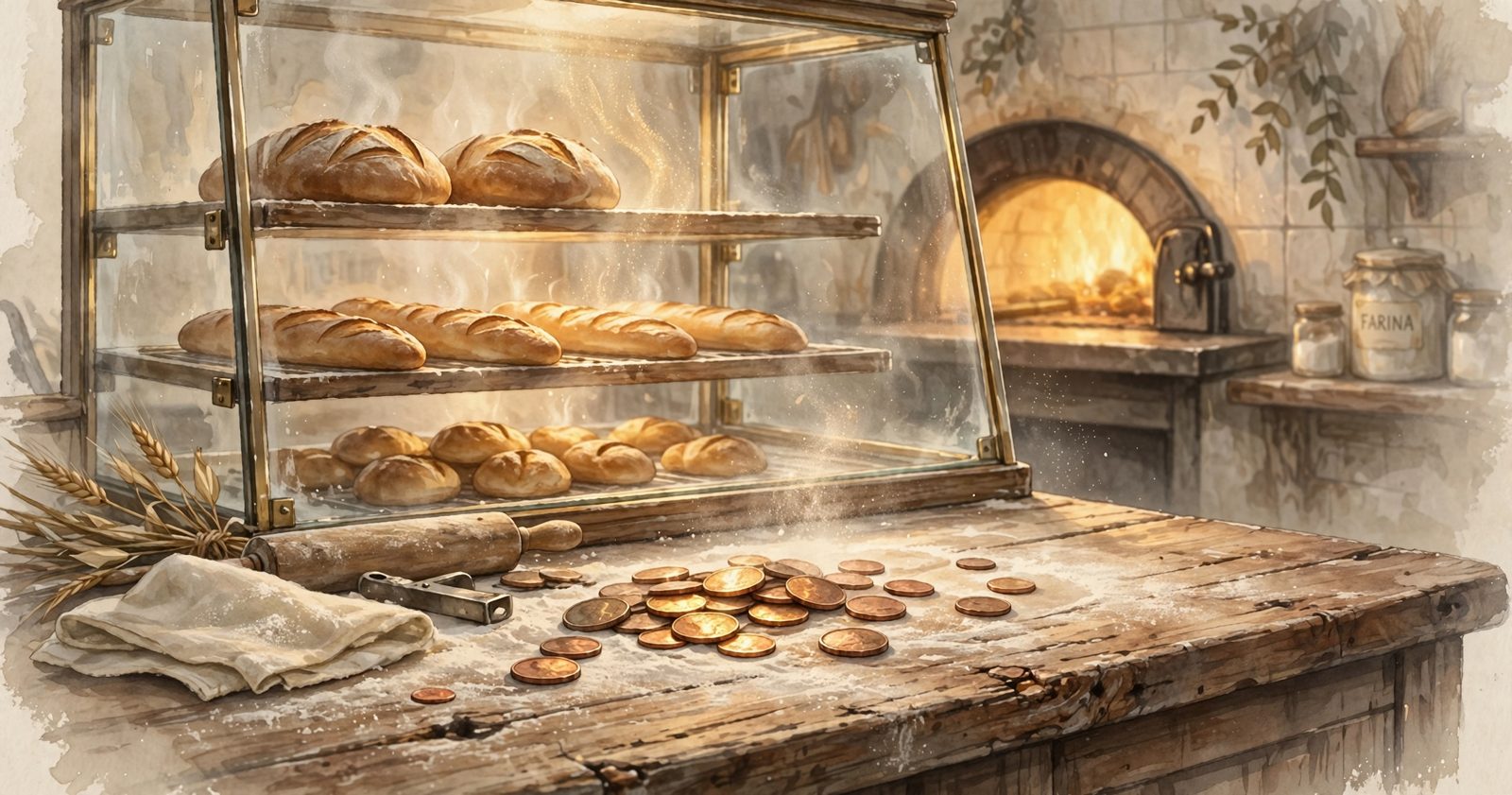
Rosa Delgado learned to count change before she learned to ride a bike. The oldest of six, she was put behind the counter of her family's bakery in San Antonio at twelve years old, tall enough to see over the register if she stood on the balls of her feet, and from that spot she watched the whole neighborhood come and go for the price of a sweet roll. She learned which customers wanted conversation with their coffee and which ones just wanted their bread wrapped quick and quiet. She learned how to make a line of waiting people feel like they weren't waiting at all. Nobody taught her this so much as she absorbed it, the way flour gets into the creases of your hands and stays there even after washing.
She married Ernesto in 1961, and the two of them raised four children in the apartment above the shop, so that the smell of the ovens below was simply the smell of being home. The children fell asleep some nights to the sound of pans being scraped clean and woke some mornings to the thump of the delivery truck before dawn. It was not a quiet life. It was not supposed to be. Rosa ran that household the way she ran the counter below it — with an eye for who needed what before they had to ask, and very little patience for anyone who complained on an empty stomach.
That, in fact, became the rule the whole family learned to live by, repeated so often it stopped sounding like advice and started sounding like weather, just a fact of the world: feed people first, then ask what's wrong. It did not matter if the trouble was a skinned knee, a lost job, or a broken heart. It did not matter if the person at her table had come from around the corner or across the country. Rosa's answer to nearly everything was a plate, set down without ceremony, and the understanding that the talking could wait until after the eating. There was something almost stubborn in her insistence on this order of operations, as if she believed — correctly, as it turned out, more often than not — that most sorrows get smaller once a person's hands are busy and their stomach is full.
Christmas Eve was where this philosophy found its fullest, most ceremonial expression. Every year, Rosa chose one grandchild to stand beside her at the counter and learn to fold tamales, and every year that grandchild discovered that this was not a casual honor. She did not accept sloppy work. The masa had to be spread just so, the filling placed with restraint, the corn husk folded and tucked with a tightness that could survive the steam, the heat, the whole violent process of becoming dinner. "If it falls apart in the pot," she would say, not unkindly but without appeal, "it was never really folded." Children who tried to slip out of the kitchen early, certain their effort was good enough, were called back without even having to turn around — she always knew. There was no leaving until the fold held. It was a small test, repeated every year, about patience and care and doing a thing properly even when no one was watching the steamer but her.
What nobody quite realized, in the thick of flour and the noise of six people in a kitchen built for two, was that Rosa was also keeping a ledger of them all. Not in any book meant for it — in the back pages of the bakery's order book, in pencil, where invoices for wedding cakes and birthday orders gave way, a few pages in, to a different kind of inventory entirely: names, and the dates that mattered to them. She never missed one. Birthdays arrived at the table as a cake, a candle, a sung verse slightly off-key, and nobody had to wonder whether Rosa would remember, because the pencil marks in that order book were as reliable as the sunrise, and she consulted them the way other people consult a calendar hanging by the phone. It was, in its way, the same impulse as the tamales and the saying about feeding people — a belief that love was not an abstract thing you felt privately, but something you had to do, on a schedule, with your hands, again and again, whether or not anyone noticed the effort behind it.
It is worth sitting with what that counter and that kitchen actually held, over all those years. A twelve-year-old girl growing into a woman who ran a household and a business with the same unfussy competence. A marriage that started in 1961 and built itself a life literally on top of the place where she'd grown up, as though she'd simply added a floor to her own history rather than starting a new one. Four children raised within earshot of ovens. Grandchildren lined up, one Christmas Eve at a time, to be initiated into the family's one unbendable culinary law. A ledger of birthdays kept not out of obligation but because forgetting one would have felt, to her, like a kind of failure far worse than a burnt batch of bread.
There is a particular kind of strength that doesn't announce itself, that looks, from a distance, like nothing more than a woman standing behind a counter, or a woman at a stove, or a woman with a pencil adding one more name to a list on the back page of a book meant for flour orders. But look closer and it is the architecture that held an entire family up for decades. Rosa Delgado's love did not often come wrapped in long speeches. It came wrapped in corn husks. It came as a plate set down before the hard conversation started. It came as her memory, sharper than anyone gave her credit for, recalling exactly how old each grandchild was turning before they'd even thought to remind her.
What she built, in the end, was not just a bakery or a household but a set of rituals sturdy enough to pass down — a fold that had to hold, a saying that answered half of life's problems, a page of pencil marks that never once went blank on someone's birthday. Those rituals outlast the specific days they were made for. They are what a family keeps closing its hand around, long after the kitchen above the bakery has gone quiet, long after the order book itself might be lost to a drawer somewhere — because the real ledger was never the paper. It was every person at that table who learned, from Rosa Delgado, that to be loved by her meant to be fed, to be remembered, and to be told, gently but without exception, that your fold was not yet tight enough. Try again. She would wait. She always did.
⤓ Download this story as a PDF
Write a story like this — for someone you love
Share a few memories and Fablely writes it in about 30 seconds. Read the opening free; keep the whole story for $9, with a print-ready PDF and a private link for family.
✦ Write your story — freeMade with Fablely — the AI story & biography generator.