Memory
Gerald the Moose, and the Dark That Didn't Scare Us
Four days without power, and I never felt safer.
Example. Fablely wrote this from a few sample memories about a made-up family, so you can see what you'd get. Write one about someone you love — the opening is free →
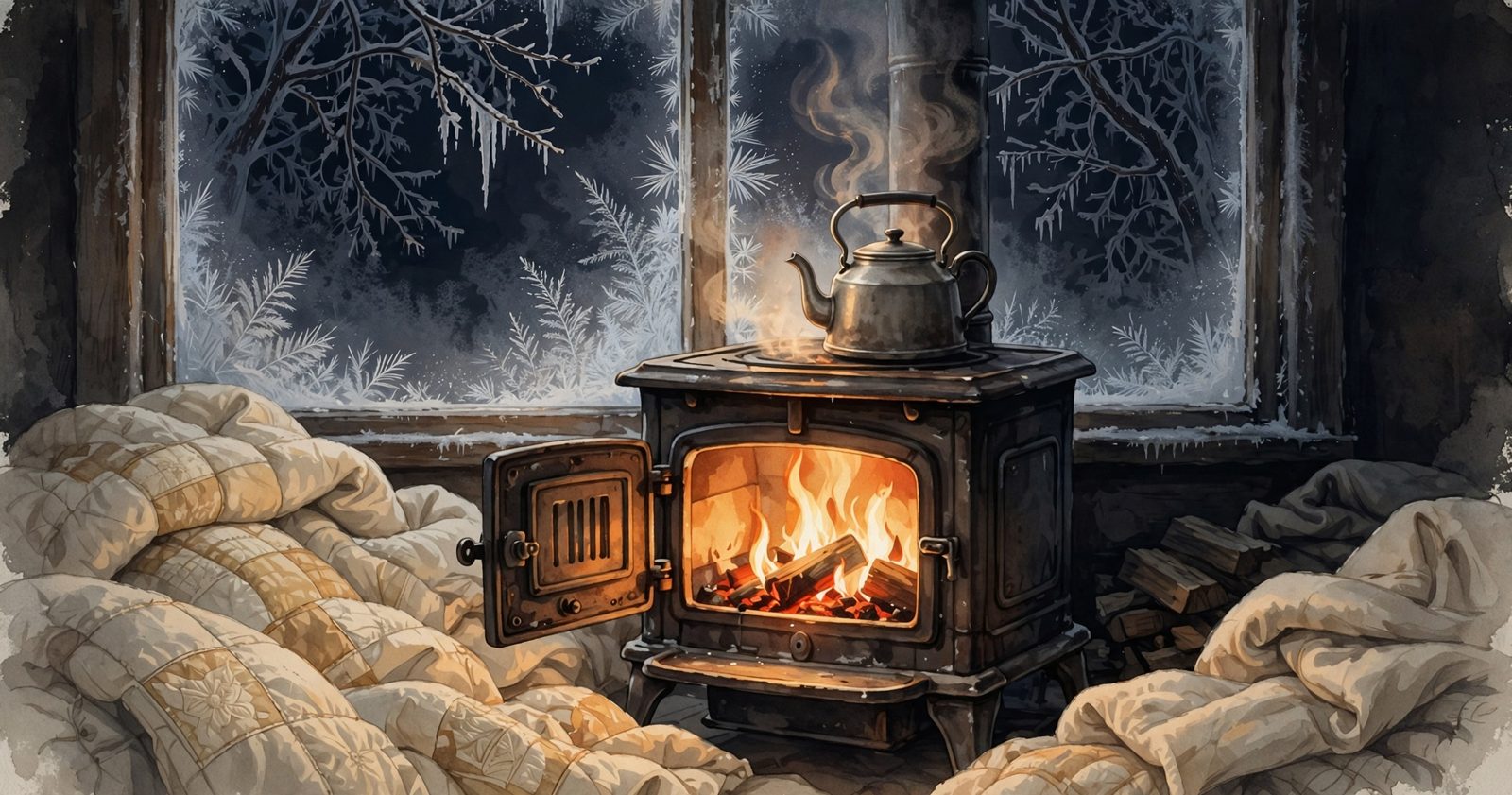
The ice came first as sound — a ticking on the windows, fine as sewing needles, and then as silence, the particular silence of a house with no hum in it. No refrigerator, no furnace, no clock radio Dad liked to leave on low in the kitchen. Outside our farmhouse, past Montpelier, the trees were bending under glass. Branches let go all night long with a sound like something being slowly unwrapped, and then a crack, and then the softer sound of them landing in snow that was already a foot deep. I was eight years old, and I remember thinking the whole world had been dipped in something and left to harden.
The power went out that first evening and did not come back for four days. Dad didn't make it into a crisis. He made it into a stove.
He'd banked that wood stove like he'd been waiting his whole life for an excuse to really use it. By the second night he had a rhythm — up every few hours to feed it, standing in the orange light in his sock feet, listening to the house the way you'd listen to a person you loved, checking that it was still breathing right. He kept that fire going from the first evening clear through, and the kitchen became the only warm room in the world, which meant it became the only room, period. We dragged quilts in. We dragged ourselves in. The rest of the farmhouse went cold and dark and faraway, like a wing of a house in a story, and the kitchen held all of us like the inside of a lantern.
That's where the stories started. Dad was not, as far as I knew, a man who told stories — he fixed things, he worried about the truck, he read the paper with his glasses low on his nose. But something about the dark pulled a different person out of him, or maybe just let one out that had been in there the whole time, waiting for the lights to go off. By candlelight, with the wind finding every gap in the window frames, he started on Gerald.
Gerald was a moose, Dad told us, enormous and gentle and secretly a coward, and his one great fear in all the world was snow. Which was, Dad pointed out, a real problem for a moose living in Vermont. Every night brought a new chapter. Gerald hiding behind a church. Gerald trying to convince a family of beavers to build him a roof over his favorite meadow. Gerald mistaking a dog for a wolf and running four miles in the wrong direction before realizing his error in front of an audience of unimpressed cows. Dad did voices. He did a specific, strangled, dignified voice for Gerald that cracked every one of us up, every single night, no matter how many times we'd heard it. I don't know where he was pulling it from. I only know that outside, the ice was taking down power lines across three counties, and inside, we were laughing so hard about a moose that I forgot to be scared of the dark, forgot to miss the television, forgot that the pipes might freeze and that this was, by any adult measure, an emergency.
On the third night Dad let us roast hot dogs over the stove. He found the long fork from somewhere — the fondue set, maybe, or some camping box in the mudroom — and he held the first one himself to show us how close was too close, and then he handed it over and let us take turns, let us argue about whose was done and whose was burnt, let the kitchen fill up with that smell of charred skin and woodsmoke that I can still call up whole, all these years later, if I close my eyes and try. We ate sitting cross-legged on the floor because the chairs felt too formal for an occasion like this, this strange holiday the storm had handed us. Then he helped us drag our sleeping bags down from our rooms — rooms that had gone genuinely cold, breath-fogging cold — and we made a pile of ourselves on the kitchen floor in front of the stove, all of us together in one room for reasons that had nothing to do with rules and everything to do with heat.
I remember looking up at the ceiling that night, lit orange and flickering, and feeling a kind of happiness that didn't have an occasion attached to it, the way birthdays or holidays do. It was just a Tuesday, or a Wednesday, made of nothing but cold and dark and my father's voice doing a moose impression. I didn't know yet that you're supposed to measure good childhoods by the big days — the trips, the presents, the parties. Nobody had told me yet that this was supposed to be a hardship, four days without power in an ice storm, pipes at risk, roads impassable, my parents surely doing math in their heads about food and firewood and how many more nights this could go on. None of that reached me. What reached me was the fork with the hot dog on it, and Gerald refusing to cross a parking lot because someone had mentioned, offhand, that it might snow there eventually.
I think now about what it must have taken for Dad to keep that version of himself going for four days straight — to get up at two in the morning to feed a stove, to keep inventing new trouble for a fictional moose when he was surely exhausted, when he was surely worried, in the part of his mind we weren't allowed into, about frozen pipes and downed lines and how long this could possibly last. He didn't let any of that reach us either. He built a kind of room inside the room, warm within the warm, where the biggest problem in the world was whether Gerald would ever make peace with winter. That takes a particular kind of strength, the quiet kind that doesn't announce itself, that just keeps feeding the fire and keeps doing the voice even on the third night when his throat must have been tired of it.
The lights came back on the fourth day, I'm told, though I don't actually remember that part — I don't remember the hum returning, or the refrigerator clicking back to life, or the candles being blown out for good. What I remember is the version before that, the version that lasted four days and has lasted thirty years longer than that in my mind: my father in the stove-light, a hot dog browning over the flame, a moose named Gerald still out there somewhere, afraid of snow, and all of us on the kitchen floor, warm, together, and certain — the way only a child can be certain — that nothing bad could reach us as long as he was the one keeping the fire going.
⤓ Download this story as a PDF
Write a story like this — for someone you love
Share a few memories and Fablely writes it in about 30 seconds. Read the opening free; keep the whole story for $9, with a print-ready PDF and a private link for family.
✦ Write your story — freeMade with Fablely — the AI story & biography generator.