Biography
Mail from Home
The life of Eleanor Park, in night shifts and postcards
Example. Fablely wrote this from a few sample memories about a made-up family, so you can see what you'd get. Write one about someone you love — the opening is free →
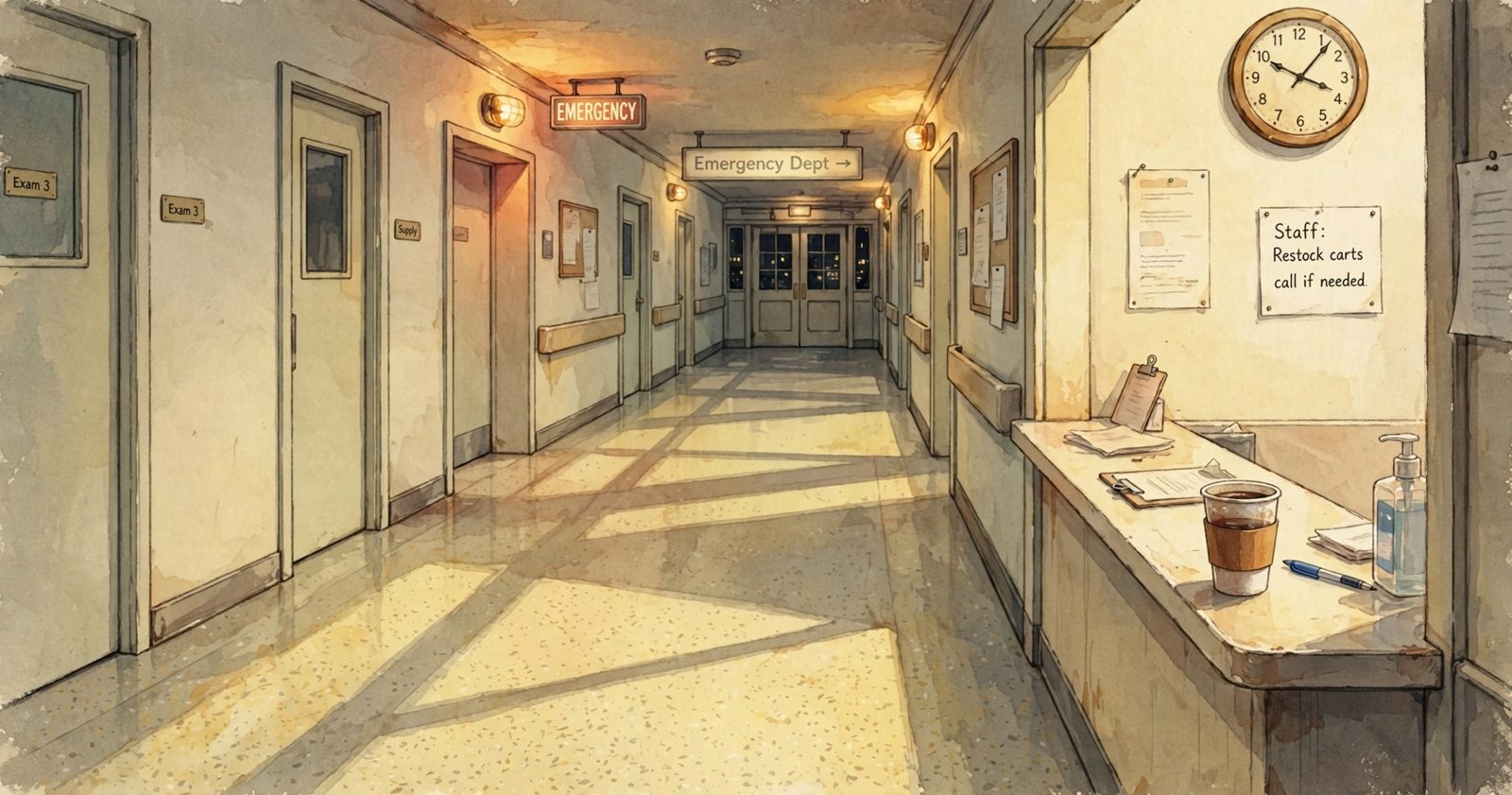
Eleanor Park was born in 1938 in Honolulu, the daughter of a pineapple-cannery foreman, into a world that ran on the rhythms of harvest and whistle and shift change. It was, perhaps, a fitting start for a woman who would spend most of her working life organizing her hours around other people's emergencies — who would come to know, long before she ever said it aloud, that some of the most important work in the world happens while everyone else is asleep.
At nineteen she left the islands for San Francisco, a young woman crossing an ocean to train as a nurse at St. Mary's. It is worth pausing on that decision, the sheer nerve of it: a cannery foreman's daughter, setting out alone for a city of fog and hills and strangers, to learn how to save lives. Whatever fear she carried with her, she did not let it turn her back. She finished her training and stayed.
Thirty-One Years of Night
What follows is, on paper, a single line: thirty-one years in the emergency room, working nights. But thirty-one years of night shifts is not a line — it is a vocation lived in the hours when most of the world has turned its lights off. It is the particular exhaustion of walking into a hospital as the sky goes dark and walking out as it goes pale again. It is missed dinners and missed holidays and a sleep schedule that never quite matched anyone else's, traded for the chance to be the steady hand in the room when someone else's worst night was happening.
Eleanor became one of the first nurses at her hospital to specialize in burn care — a field that asks for a particular kind of courage, since burn injuries are among the most painful and frightening wounds a person can carry, and the nurses who treat them must be equal parts clinician and comfort. To choose that specialty, and to be among the first to do so, suggests a woman who did not shy from the hardest rooms in the building. She went toward the cases that required more: more patience, more gentleness, more of whatever reserve of calm a person has to keep refilling after it runs dry.
And then, as if thirty-one years of nights and a specialty in burn care were not enough, there were the Saturday mornings — the one slice of ordinary daylight she carved out to teach first aid at the YMCA. It is easy to imagine what those classes must have been: a room of neighbors and teenagers and young parents learning to wrap a bandage or clear an airway, taught by someone who had seen, in the small hours of countless nights, exactly why those small skills mattered. She didn't just treat emergencies. She tried to make sure fewer people would need her.
A Life Without a Ledger
Eleanor never married. It is tempting to frame that fact as an absence, but nothing in the shape of her life suggests emptiness — only a different allocation of devotion. Her care went out across a wider net: to patients she treated and released back into their lives, to students on Saturday mornings who carried her instructions home with them, and, as it would turn out, to a family of nieces and nephews who received her attention in a form all their own.
When she finally retired, after three decades of giving her nights away, Eleanor did something that reads almost like a correction — she went out to meet the daylight she'd missed. She traveled to forty countries. Forty is not a number people arrive at by accident or by a single lucky trip; it is a number built one flight, one visa stamp, one unfamiliar alphabet at a time, over years of deliberate wandering. The nurse who had spent her career tending to people in crisis spent her retirement seeking out the world freely, on her own schedule, answerable to no shift and no supervisor but her own curiosity.
And from every one of those forty countries, she sent a postcard to every niece and nephew. Not one postcard from the trip — one from each country, to each child. The arithmetic alone tells you something about her: the discipline of it, the refusal to let anyone feel forgotten just because they were thousands of miles and many years removed from her. Somewhere in a market stall or a train station or a post office with a sign she couldn't read, Eleanor Park was thinking of family, counting names, making sure no one was left out of the ritual.
The Shoebox
She kept every reply in a shoebox labeled "Mail from home." It is a small detail, almost too plain to carry the weight it does, and yet it may be the truest self-portrait she left behind. A woman who had given her working life to institutions — the hospital, the Y — kept the proof of her family's love in the humblest container she could find, and gave it the plainest, most devastatingly honest label imaginable. Not "keepsakes." Not "letters." Mail from home. As if, after all her traveling, after all those nights spent anchoring other people through their worst hours, what she needed anchored was herself — and what did it was a shoebox of crayon drawings and clumsy handwriting and news from nieces and nephews who could not have known how much those envelopes meant when they licked them shut.
There is a kind of symmetry in that image worth sitting with: Eleanor spent thirty-one years as the person who showed up when things went wrong, who taught others how to do the same, and then spent her later years as the one who went out into the world and refused to let distance sever her from the people she loved. The postcards went out; the letters came back; the shoebox filled. It was its own kind of night shift — the long, patient work of staying connected — conducted this time entirely in daylight, and entirely by choice.
What she leaves behind is not a single dramatic story but a life built almost entirely of steadiness: steady through the hardest shifts in the emergency room, steady in a specialty that demanded extraordinary gentleness, steady enough to show up every Saturday morning for people who weren't even patients yet, and steady, finally, in making sure that distance and time never got to decide how close she stayed to her family. She was the aunt who remembered every name, from every country, every time. She was the woman who chose, again and again, to be the one who was there — in the ward at 3 a.m., in the gym on a Saturday, in a stamped envelope from somewhere far away.
The shoebox still exists, presumably, somewhere among her things — proof that even a woman so devoted to the wider world and the hardest nights never stopped holding onto the small, plain, irreplaceable evidence that she was loved back. That may be the simplest way to remember Eleanor Park: not only as a nurse, a teacher, or a traveler, but as someone who understood, long before anyone had to tell her, that home is not a place you stay in — it is something you keep sending for, and keep saving, no matter how far you've gone.
⤓ Download this story as a PDF
Write a biography like this — for someone you love
Share a few memories and Fablely writes it in about 30 seconds. Read the opening free; keep the whole biography for $9, with a print-ready PDF and a private link for family.
✦ Write your biography — freeMade with Fablely — the AI story & biography generator.