Tribute
Measure Twice
In memory of Walter Hughes, a gentle teacher of hands and hearts
Example. Fablely wrote this from a few sample memories about a made-up family, so you can see what you'd get. Write one about someone you love — the opening is free →
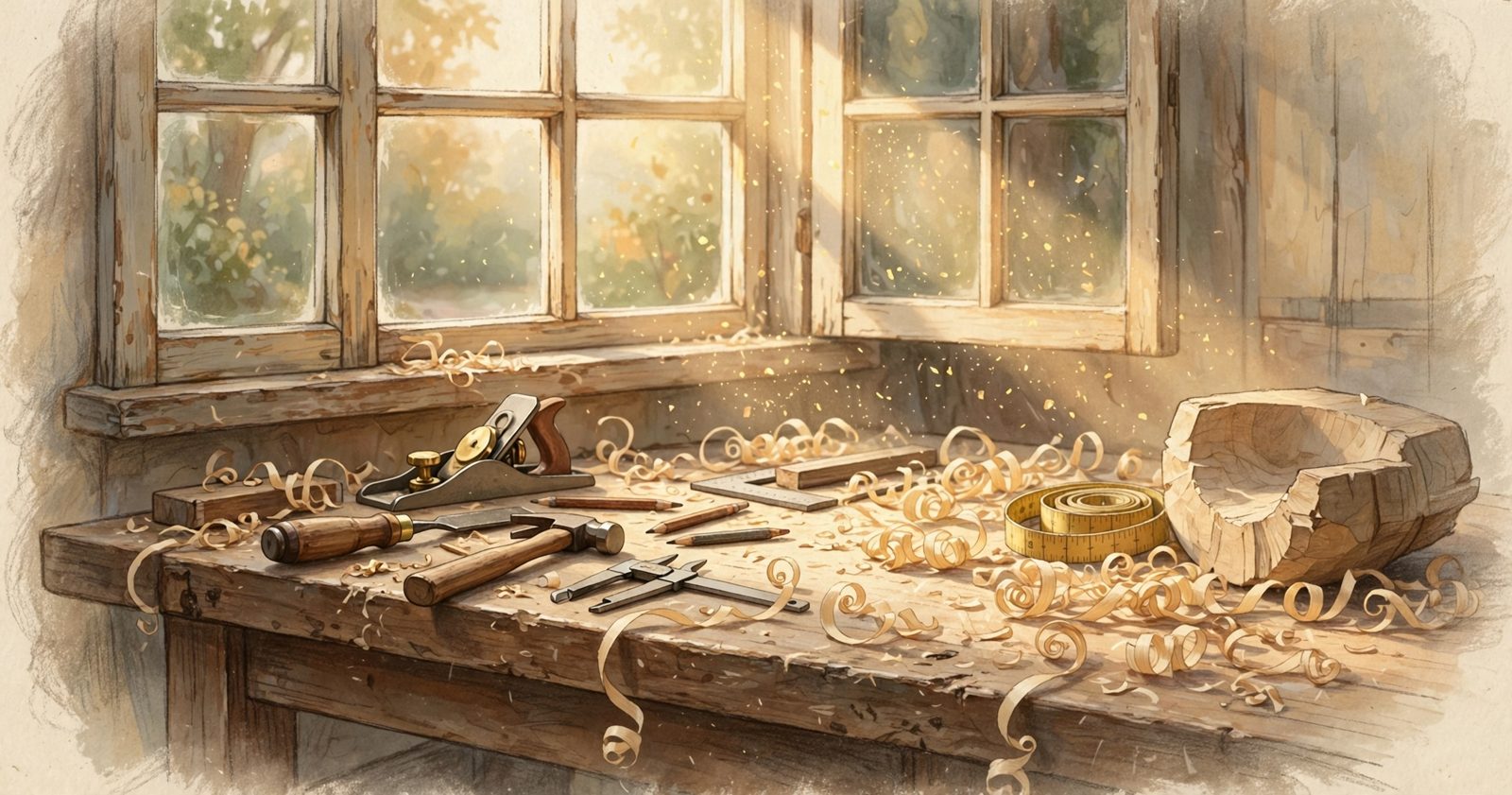
Walter Hughes spent thirty-four years in the shop room of a Duluth high school, teaching teenagers how to hold a saw steady and how to respect a piece of wood enough to measure it twice before cutting it once. It was the kind of lesson that sounded small until you realized he never really meant it about wood at all. He said it about people, too — about patience, about looking closely before you judged, about the value of getting something right the first time because second chances weren't always waiting around the corner. The students who passed through his classroom over three decades likely remember the sawdust and the hum of the lathes, but those who knew him well understood that what he was really teaching was care.
That same care showed up everywhere in his life, in ways so quiet they might have gone unnoticed if you weren't paying attention. He could fix anything with a hinge or a motor — a stuck door, a stubborn mower, a bicycle chain that had given up — and he did it without fanfare, the way some men hum while they work. There was no problem too small for his attention and no fix too humble to be worth doing well. He coached Little League for years, out on fields that were probably too cold more often than not, and in all that time he never once yelled at an umpire. Not when the call went against his own team, not when it cost them a game. He simply believed that how you lost mattered as much as whether you won, and he lived that belief out loud in front of a lot of ten-year-olds who were watching more closely than he probably knew.
But it was the mornings on Lake Superior that held something even quieter, something just between a father and his child. Every Saturday, before the sun had any intention of rising, Walter would wake early and head out onto the water, his son or daughter half-asleep beside him in the boat. The lake in those hours was a different world — dark, enormous, and still, the kind of quiet that makes a person feel both small and completely at peace. He never said much out there. He didn't have to. He'd bait the hook himself, feel for that first tug on the line, and then, just as the fish began to fight, he'd hand the rod over so that the reeling-in — the triumph, the thrill, the bragging rights — belonged entirely to his child. He never took that moment for himself. He gave it away, every single Saturday, without ever once mentioning that he was doing it.
That was the shape of Walter Hughes's love: unannounced, practical, steady as a heartbeat. He wasn't a man who spoke in grand declarations. He showed up. He fixed what was broken. He woke up before dawn. He stood at the edge of a baseball diamond in the cold and clapped for every kid on the team, not just his own. He handed over fishing rods and credit and quiet encouragement, again and again, until it became simply who he was — not a gesture he made but a character he had built, plank by plank, the same patient way he built everything else.
A Life Measured Well
There is a particular kind of man who leaves his mark not through words but through the steadiness of his hands and the consistency of his attention, and Walter Hughes was that kind of man. Generations of students sat in his classroom and left knowing how to fix something themselves instead of needing someone else to do it for them — a gift that outlasts almost anything else a teacher can give. Parents on the Little League sidelines came to expect his calm, the way he never let a bad call rattle him, the way his presence alone seemed to lower the temperature of a tense inning. And his own children came to know, in that unspoken way children know things about their fathers, that being loved by Walter Hughes meant being handed the good part — the reel, the rod, the catch — while he stood by, satisfied simply to have made it possible.
Maybe that's what "measure twice, cut once" really meant when he said it about people. He was telling you to look carefully before you acted, to think about the person in front of you before you spoke or judged or reacted. He lived by it in the shop room, where a careless cut could ruin good lumber, and he lived by it on the ball field, where a careless word could ruin a child's confidence, and he lived by it in a boat on Lake Superior, where a careless move might have taken the joy out of a six-year-old's first fish. Everything he touched, he touched deliberately. Everything he gave, he gave on purpose.
He was eighty-one when he died, in March, at home, with a ballgame playing on the radio. There is something fitting in that — something that feels, even now, like one last quiet gift. No hospital hum, no fluorescent lights, just the familiar rhythm of an announcer's voice calling balls and strikes, the same sound that had likely filled his afternoons and evenings for most of his life. It was the sound of baseball season returning, the sound of patience rewarded, the sound of something ordinary and beloved continuing on as it always had. He went out the way he lived: unhurried, unbothered by fuss, surrounded by something familiar and good.
It is hard to measure a man like Walter Hughes, though he would probably appreciate the irony in that. How do you measure thirty-four years of shop classes, the exact number of hinges mended, motors coaxed back to life, umpires never shouted at? How do you measure a hundred Saturday mornings on a lake that never seemed to run out of fish, or the particular silence of a father letting his child have the glory of the catch? You can't, not really — not with any tool he ever kept in his shop. But you can feel the shape of it in the people he taught, coached, and raised. You can feel it every time someone picks up a tool and thinks before they cut. You can feel it on a quiet lake at dawn. You can feel it, even now, in the stillness after a ballgame ends, when the stadium lights go dark and the only thing left is the hush of something good having happened.
Walter Hughes measured carefully, all his life — his cuts, his words, his patience, his love. He got it right. And what he built with all that care outlasts him now in the steadiest way a man's life can: in the people who learned, by watching him, how to be patient, how to be kind, and how to let someone else have the rod when the fish finally bites.
⤓ Download this story as a PDF
Write a tribute like this — for someone you love
Share a few memories and Fablely writes it in about 30 seconds. Read the opening free; keep the whole tribute for $9, with a print-ready PDF and a private link for family.
✦ Write your tribute — freeMade with Fablely — the AI story & biography generator.