Memory
The Dented Thermos
What Grandpa Joe taught without ever raising his voice
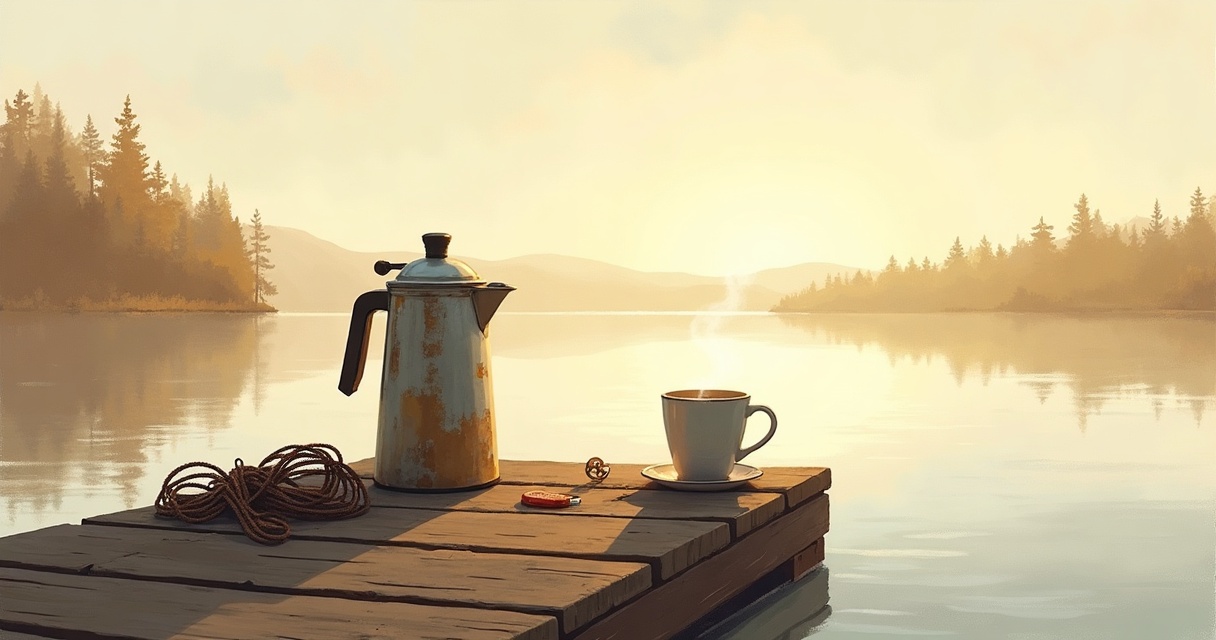
The lake was always black-glass quiet when we got there, the sky just barely thinking about turning gray at the edges. Grandpa Joe never rushed those mornings. He'd cut the truck engine and let the silence settle over us like something sacred before he'd even reach for the tackle box, and I understood, even as a kid too young to say it, that this was the whole point — not the fish, but the stillness before everything.
He'd hand me the thermos first, always. It was dented on one side, the metal gone dull with age, the cup-lid stubborn and hard to twist. I don't think he owned another one. It didn't matter that it was banged up — maybe that was even why he kept it. He'd pour the coffee for himself and something warm and milky for me, and we'd sit at the edge of the water with our lines out, not talking much, just watching the sky do its slow work of waking up.
He taught me to fish the way he taught me most things — without ever really seeming to teach at all. He'd just do it, again and again, patiently, until I understood by watching. How to bait the hook without flinching. How to cast so the line didn't tangle. How to wait. Grandpa Joe was a great believer in waiting. He never once told me to be patient. He just was patient, sitting there beside me, and somehow that was the lesson.
The Sound of the Garage
If the lake was where he was quiet, the garage was where he hummed. There was a tune he whistled — I never learned its name, never asked, and now I wish I had — but I'd know it anywhere. It followed him around like a shadow made of sound. He whistled it fixing the lawnmower, whistled it under the hood of the car, whistled it hunched over some drawer of loose screws and rusted hinges he swore he'd use again someday.
The garage smelled like oil and sawdust and something metallic that I can still conjure if I close my eyes. Grandpa Joe fixed things not because he had to, but because he liked the fixing — liked the problem of it, the quiet satisfaction of something broken becoming whole again in his hands. I'd sit on the old stool in the corner and watch him work, and that tune would wind through the air between us, steady as a heartbeat, and I never once saw him frustrated, never once saw him slam a wrench down or curse at a stripped bolt. He'd just pause, look at the thing a little longer, and keep going.
The Way He Spoke
What strikes me most now, looking back, is that Grandpa Joe never raised his voice. Not once. Not when I dropped his good pliers in the grass and lost them for a week. Not when I backed his truck into the mailbox at fifteen and stood there waiting for the storm. There was no storm. There was just Joe, walking out slow, looking at the damage, looking at me, and saying something quiet enough that I had to lean in to hear it.
But you always knew exactly where you stood with him. That was the strange magic of it — he didn't need volume to make a point land. A certain stillness in his face, a certain flatness in his tone, and I'd feel the weight of whatever I'd done settle right into my chest, heavier than any shouting could have made it. And when he was proud of you, it worked the same way in reverse. A small nod. A "good" muttered almost to himself. It was enough to make you feel ten feet tall for a week.
I think now that this was its own kind of gift, the not-raising of his voice. It meant that when Grandpa Joe did speak, you listened, because his words weren't cheapened by overuse. He didn't waste them. He saved them the way he saved everything — the coffee grounds he swore weren't stale yet, the tune he whistled instead of singing, the thermos that any other man would've thrown away years before I ever held it.
What Stayed
I think about those lake mornings more than almost anything else from childhood — the way the water would go from black to silver as the sun came up, the way Grandpa Joe would nudge me with his elbow when a fish tugged the line before I'd even noticed, never grabbing the rod from my hands, just letting me feel it, fumble it, reel it in myself, badly, gloriously. He wasn't showing me how to catch fish, not really. He was showing me how to be still with another person without needing to fill the silence. How to work with your hands until something bent right. How to let your actions speak instead of your volume.
I still have the thermos. It sits in my kitchen cabinet now, more dent than shine, the lid still stubborn to twist, and some mornings when the house is quiet and everyone else is asleep, I'll pour my coffee into it just to hold something his hands held so many times before mine ever did. I don't fish much anymore. But some mornings I'll go stand outside anyway, right at that hour when the sky is deciding what color it wants to be, and I'll find myself waiting for nothing in particular, the way he taught me to, patient as still water.
And every so often, working on something small and broken around the house — a wobbling chair leg, a drawer that sticks — I catch myself humming. Not his tune exactly. I never learned it well enough to get it right. But something like it. Something low and steady, moving through my chest the way it used to move through his, filling up a quiet room the way he always did — without a single raised word, and without ever needing one.
⤓ Download this story as a PDF
Write a story like this — for someone you love
Answer a few prompts and Fablely's AI turns your memories into a heartfelt life story, biography, or tribute. Free to try.
✦ Create your own storyMade with Fablely — the AI story & biography generator.